
Our Work · Vertical 4 of 5
Sarvātmabhāva · सर्वात्मभाव
Cultural Mobilisation
& Social Cohesion
Adi Shankaracharya bequeathed Bharata two complementary paths of engagement with Advaita Vedanta — the Bhāṣyas, a rigorous tradition of philosophical inquiry and scriptural interpretation, and the Stotras, which made the same vision accessible through devotion, reflection, and daily practice — one path of intellectual investigation, the other of lived spiritual experience. HH Sri Sri Shankara Bharati Mahaswamiji has carried both into the present age: renewing the study of the Bhāṣyas for contemporary seekers through research, education, and public engagement, while taking Stotra Pārāyaṇa from the individual to the civilizational scale — using mass chanting not merely as devotion but as an instrument of social harmony and national integration, rooted in Adi Shankaracharya's vision of Sarvātmabhāva, the underlying oneness of all existence.
1,62,302
Devotees — Namah Shivaya Mahasamarpane · India Book of Records
70,000+
Youth at the Vivekadeepti Maha Samarpane, Palace Grounds
10 Lakh+
Students taught Vivekadeepini across Karnataka
24
Indian languages carrying the Prashnottara Ratnamalika forward
Anchor One
Stotra Parayana & Mahasamarpane Samaveshas
At the heart of Cultural Mobilisation lies a single, repeating rhythm: a hymn of Adi Shankaracharya taken up quietly in thousands of homes over months of steady parayana, then gathered — all at once — into a great Samavesha where lakhs chant as one. Each movement below follows this same arc, from the discipline of the individual to the unity of the assembled nation.
 Lakhs gathered in a single Samavesha — the Palace Grounds, Bengaluru
Path 1
A path for every seeker
Where the Bhashyas demand rigorous study, the Stotras ask only devotion — making the highest truths of Advaita Vedanta accessible to the scholar and the layperson alike.
Path 2
What it does for the one who practises
Parayana steadies and purifies the mind — chitta shuddhi — cultivating the one-pointed devotion that gently prepares a practitioner for deeper contemplation, even as it stands complete in itself.
Path 3
What it does for the many, together
Chanted in unison by lakhs at once, the same stotra makes no distinction of caste, language or class — using shared sound to dissolve what divides, and to bind the nation in a single voice.
Anchor One · Sri Dakshinamurthy Ashtaka
Vivekadeepti — Sri Dakshinamurthy Ashtaka
Of all the stotras Adi Shankaracharya composed, the Sri Dakshinamurthy Ashtaka stands apart — not only a hymn of praise but the whole of Advaita Vedanta compressed into eight luminous verses, in which the Supreme reveals itself through silence alone. Vivekadeepti places this hymn, and the discernment it awakens, into the hands of the young.
 Over 70,000 youth chanting the Ashtaka in unison — Palace Grounds, 2026
Vivekadeepti is Vedanta Bharati’s movement to place the Sri Dakshinamurthy Ashtaka — and the discernment (viveka) it awakens — into the hands of the young. Built as a compact, contemplative course, it is designed to help young minds see through impermanence, quieten the ego, anchor the mind in reality, and find in bhakti and wisdom a path to both inner peace and outer purpose.
Why the Dakshinamurthy Ashtaka
Where other stotras kindle devotion, this one kindles insight — turning a young seeker’s attention inward, from the noise of the world to the unchanging awareness that witnesses it.
From practice to Samavesha
As with every Vedanta Bharati movement, the Ashtaka was first learnt and recited across countless centres and households — steady, repeated parayana — before practitioners were mobilised into a single grand offering.
The Vivekadeepti Maha Samarpane, 2026
In 2026, this year-long discipline gathered into one overwhelming evening at the Palace Grounds, Bengaluru. Over seventy thousand young men and women — students, seekers and volunteers who had made the Ashtaka their own — chanted its eight verses in unbroken unison, offering the fruit of their parayana at the feet of the silent Guru.
70,000+
young voices chanting the Sri Dakshinamurthy Ashtaka as one — the largest gathering yet assembled around Shankara’s hymn of Self-knowledge, at the Palace Grounds, Bengaluru.
8
Verses of the Ashtaka — Advaita Vedanta in miniature
70,000+
Youth at the 2026 Maha Samarpane
2026
Palace Grounds, Bengaluru
Where the mass chanting of the Soundaryalahari carried devotion to civilizational scale, Vivekadeepti carries discernment — turning Shankara’s silent teaching into the shared inheritance of a new generation.
Photo & video — Vivekadeepti Maha Samarpane
Anchor One · Stotra Parayana Mahabhiyana
Triveni Stotra — Namah Shivaya & Stuti Shankara
A confluence of three hymns of Adi Shankaracharya, learnt by lakhs over months of parayana, then gathered into two great Samaveshas: Namah Shivaya at Bengaluru (an India Book of Records) and Stuti Shankara at the Mysore Palace.
 Namah Shivaya Mahasamarpane · Bengaluru
The occasion
To mark the fiftieth anniversary of the initiation into sanyasa of the 36th Pontiff of Sri Sringeri Sharada Peetham, Jagadguru Shankaracharya Sri Sri Bharati Tirtha Mahasannidhanam, Jagadguru Shankaracharya Sri Vidhushekhara Bharati Sannidhanam, the successor-designate, called for a year-long celebration in his honour — the Suvarna Bharati Golden Jubilee. Around it, Vedanta Bharati built the Triveni Stotra Mahabhiyana.
Three sacred hymns of Adi Shankaracharya were chosen as the offering — a Triveni, a confluence of three streams of devotion — learnt and recited by lakhs of devotees over many months of parayana:
Kalyanavrustistava
Invokes the Divine Mother through verses that open with the syllables of the Srividya Panchadasakshari Mahamantra.
Shiva Panchakshara Nakshatramala Stotra
A meditative composition carrying the Namah Shivaya mantra within it, chanted a sacred 108 times.
Lakshmi Nrusimha Karunarasa Stotra
A devotional prayer seeking protection and release from worldly suffering.
Namah Shivaya · Bengaluru
India Book of Records · 26 October 2024 · Palace Grounds, Bengaluru
The Bengaluru offering gathered all of this into a single evening. More than 1.6 lakh devotees raised their voices together in the Triveni Stotra in perfect synchrony — witnessed by the Sringeri Sannidhanam and several revered Swamijis, and presided over by the Hon’ble Vice President of India, Sri Jagdeep Dhankhar.
1,62,302
devotees chanted in perfect synchronisation — earning Vedanta Bharati a place in the India Book of Records for the largest mass recitation of shlokas.
More than a record-breaking event, the Mahasamarpane was a spiritual movement — one that unified devotees across every background, reaffirming the timeless legacy of Adi Shankaracharya.
Photo & video — Namah Shivaya Mahasamarpane
Stuti Shankara · Mysore Palace
Mysore Palace Premises · December 2025
The Mysore offering was the fruit of nearly a year of preparation. Household by household, devotees took up the three stotras through steady parayana, until 40,000 devotees rendered them in a single devotional chorus on the illuminated premises of the Mysore Palace.
40,000
devotees, gathered from across the Mysore region, rendering the Triveni Stotra in unison on the premises of the Mysore Palace.
Graced by
The Samavesha was blessed by Jagadguru Shankaracharya Sri Sri Vidhushekhara Bharati Sannidhanam of the Sri Sringeri Sharada Peetham, and graced by the presence of HH Sri Sri Shankara Bharati Mahaswamiji and HH Sri Brahmananda Bharati Swamiji, alongside distinguished scholars, guests and participants.
A region mobilised
The gathering of 40,000 was drawn together through more than 40 camps held across the region — reaching into over 30 neighbouring taluks and villages, where the three stotras were taught and practised.
Photos — Stuti Shankara Mahasamarpane
Anchor One · A Decade of Devotion
Soundaryalahari Parayanotsava
One of Vedanta Bharati's longest-running movements of collective chanting — the wave of beauty carried across a thousand centres. From its 2007 beginning at the Palace Grounds through the two-year Dashamaha Abhiyana (2015–2017), the Soundaryalahari has crossed every border, from Karnataka to Kerala, Varanasi and Hyderabad.
 The grand culmination in the presence of the Prime Minister, 29 October 2017
Where it began
The movement’s foundation was laid in 2007 at Soundaryalahari Vaibhava, Palace Grounds, Bengaluru — where more than 1.5 lakh mothers, children and men chanted the Soundaryalahari in unison, in the presence of HH Sri Sri Shankara Bharati Mahaswamiji, with Sri L.K. Advani as chief guest.
The two-year Abhiyana, 2015–2017
To mark a decade since that first gathering, Vedanta Bharati launched the Dashamaha Soundaryalahari Parayanotsava Abhiyana, beginning 11 November 2015 and concluding 15 November 2017.
The Resolve
Each parayana karta undertook a formal sankalpa to chant both the Soundaryalahari and the Dakshinamurthy Ashtakam at least 500 times across the two years.
The Impact
Participants spoke widely of this disciplined practice steadying the mind and deepening devotion — bringing many profound, deeply personal spiritual experiences.
The grand culmination, October 2017
The Abhiyana closed across two days at the Palace Grounds. On 29 October, the Mahasamarpane saw about 80,000 students and 80,000 women and gentlemen recite the Soundaryalahari in unison — held in the presence of the Hon’ble Prime Minister of India, Sri Narendra Modi.
2007
Where the movement began, Palace Grounds
500+
Recitations resolved, per practitioner
1.6 L+
Chanting together at the 2017 culmination
A movement that crossed every border
Bengaluru
Fort High School Grounds
Over 7,000 mothers and children joined the divine chanting, with Sri H.N. Ananth Kumar among the dignitaries present.
Mysuru
& beyond
Mass chanting programs across several places in Karnataka, with lakhs of devotees participating.
Kerala
Thiruvananthapuram
Thousands learnt the Soundaryalahari online, with the samarpana performed simultaneously across a number of centres.
Varanasi
April 2022
Women and students chanted en masse, with thousands of Sanyasins present on the occasion.
Hyderabad
2022
More than ten thousand ladies chanted the stotra in a single voice during the Sri Shankara Jayanti celebrations.
Photos — Soundaryalahari Parayanotsava
Anchor One · Value-Based Education
Prashnottara Ratnamalika — Vivekadeepini
Where the Stotras nourish devotion, Adi Shankaracharya's Prashnottara Ratnamalika nourishes viveka — discernment itself. Abridged into the accessible Vivekadeepini, the Torch of Wisdom, it has become a nationwide value-education movement, recognised by the Government of Karnataka and published in 24 Indian languages.
 More than one lakh students chanting Vivekadeepini — Palace Grounds, 18 Jan 2020
Recognised by the State
The Prashnottara Ratnamalika program for school children is recognised by the Department of Education, Government of Karnataka, and widely introduced in schools across the State. The then Governor, Sri T.N. Chaturvedi, inaugurated the first conference of 3,000 school children in Bengaluru.
Royal recognition
Vivekadeepini gathered 37 stanzas chosen for their relevance to students, teachers and parents. In October 2017, a copy reached the Hon’ble Prime Minister, Sri Narendra Modi — on whose direction the Sahitya Akademi began translating the original Prashnottara Ratnamalika into 24 Indian languages.
A historic launch in New Delhi
On 7 July 2019, Vedanta Bharati released the first set of Vivekadeepini in 10 languages at once. Sri M. Venkaiah Naidu, then Vice President of India, presided as Chief Guest, in the divine presence of HH Sri Sri Shankara Bharati Mahaswamiji.
Publications
English commentaries on both the Prashnottara Ratnamalika and Vivekadeepini were authored by Sri S.S. Nagananda, a trustee of Vedanta Bharati, and published in 2017 and 2019.
Carried to the Palace Grounds
On 18 January 2020, more than one lakh students from over a thousand schools of Bengaluru chanted stanzas from Vivekadeepini together at the Palace Grounds, with the Hon’ble Union Home Minister, Sri Amit Shah, as Chief Guest.
A grassroots campaign across Karnataka
Mass enrolment
Close to 10 lakh students across Karnataka have been taught the Vivekadeepini curriculum — 2 lakh of them in Bengaluru alone.
Collaborative teaching
Classes are conducted free of cost by dedicated volunteers and school teachers, covering the original verses, their meanings, and examples from modern life.
Curriculum integration
Many schools and colleges have formally folded Vivekadeepini into their Moral Education courses.
Parents and teachers have spoken, again and again, of a marked improvement in their children’s clarity of thought and ethical grounding — proof that ancient Vedantic wisdom and the contemporary classroom can meet, and meet well.
Anchor One · The Wider Garland
Other Shankara Stotras
Beyond its flagship campaigns, Vedanta Bharati has carried many more of Adi Shankaracharya’s compositions into collective practice — including the Shiva Lahari – Dashashloki Mahabhiyana and Ananda Sindhu, the Ocean of Bliss — each following the same movement from steady parayana to grand Samavesha.
 Ananda Sindhu — mass chanting of the hymns of oneness, Palace Grounds, 2013
Shiva Lahari — Dashashloki Mahabhiyana
Advaita Vedanta in Ten Verses
This movement takes up the Dashashloki — a stotra carrying major Vedantic content within just ten verses. It unfolds in two stages, a Saptaha and a Samavesha, with Gurupaduka Archana at every centre, and the chanting of the Gurvashtaka, the Nirvanashatka and the Dashashloki binding each gathering into a single contemplative thread.
Ananda Sindhu — The Ocean of Bliss
19 May 2013 · Palace Grounds, Bengaluru
Ananda Sindhu brought together the mass chanting of selected stotras of Sri Shankaracharya that highlight the oneness of all living beings — the very heart of Sarvātmabhāva. Around the chanting stood a wider celebration: competitions for students, and exhibitions of books both by and about Sri Shankaracharya.
The theme
Stotras selected specifically for their vision of universal oneness — turning a day of chanting into a meditation on the unity that binds all beings, and the nation with them.
Beyond the recitation
Student competitions and a curated exhibition of works by and on Sri Shankaracharya carried the movement into scholarship and the next generation.
Shankara Sandesha Saptaha
2004 · A Week Across Karnataka
A week-long programme bringing the vision and works of Adi Shankaracharya to communities across Karnataka through lectures by eminent scholars, held simultaneously at multiple locations. As part of the programme, scholars visited schools and colleges, engaging students with the life, teachings and works of Adi Shankaracharya. Throughout the week, devotees participated in the parayana of stotras composed by Adi Shankaracharya, creating a shared engagement with his teachings through study, reflection and recitation.
Photos — Other Shankara Stotras
Anchor Two · Discourse Series
Bhaashyaamrita-Vaahinee
For years Vedanta Bharati's work centred on Adi Shankaracharya's stotras — the path of devotion. Bhaashyaamrita-Vaahinee marked a turn towards the second path he left Bharata: his commentaries on the Upanishads themselves, the path of jnana — beginning with the Taittiriya Upanishad Bhashya across 40 centres in Bengaluru.
 The Saptaha across 40 centres · the Samaavesha at Sringeri Shankara Math
Why the Taittiriya Upanishad
The Taittiriya Upanishad Bhashya was chosen as the first step on this path. It holds, within a manageable scope, the essential concepts of the Upanishads — an ideal doorway for both the curious beginner and the earnest seeker.
Seven days, forty centres
The Saptaha unfolded over seven days, across 40 centres in Bengaluru, with discourses in both Kannada and English so the teaching could travel as widely as possible.
Expert scholars
Scholars trained in the traditional manner under accomplished Gurus led in-depth sessions on the Taittiriya Bhashya.
The format
Each session opened with the chanting of the Taittiriya Upanishad, followed by selected verses of the Harimeede Stotra — Adi Shankaracharya’s own composition.
The Samaavesha
The series closed with a grand Samaavesha at the Sringeri Shankara Math, Shankarapuram — in the divine presence of HH Sri Sri Shankara Bharati Mahaswamiji, and presided over by Hon’ble Justice A.V. Chandrashekara.
In this, Vedanta Bharati carried the nectar of the Bhashya — the Bhaashyaamrita — to the doorstep of the common seeker, bridging an ancient commentary with a modern audience.
Photos — Bhaashyaamrita-Vaahinee
Anchor Three · A City-Wide Celebration
Śaṅkara Yaśovaibhava · 2007
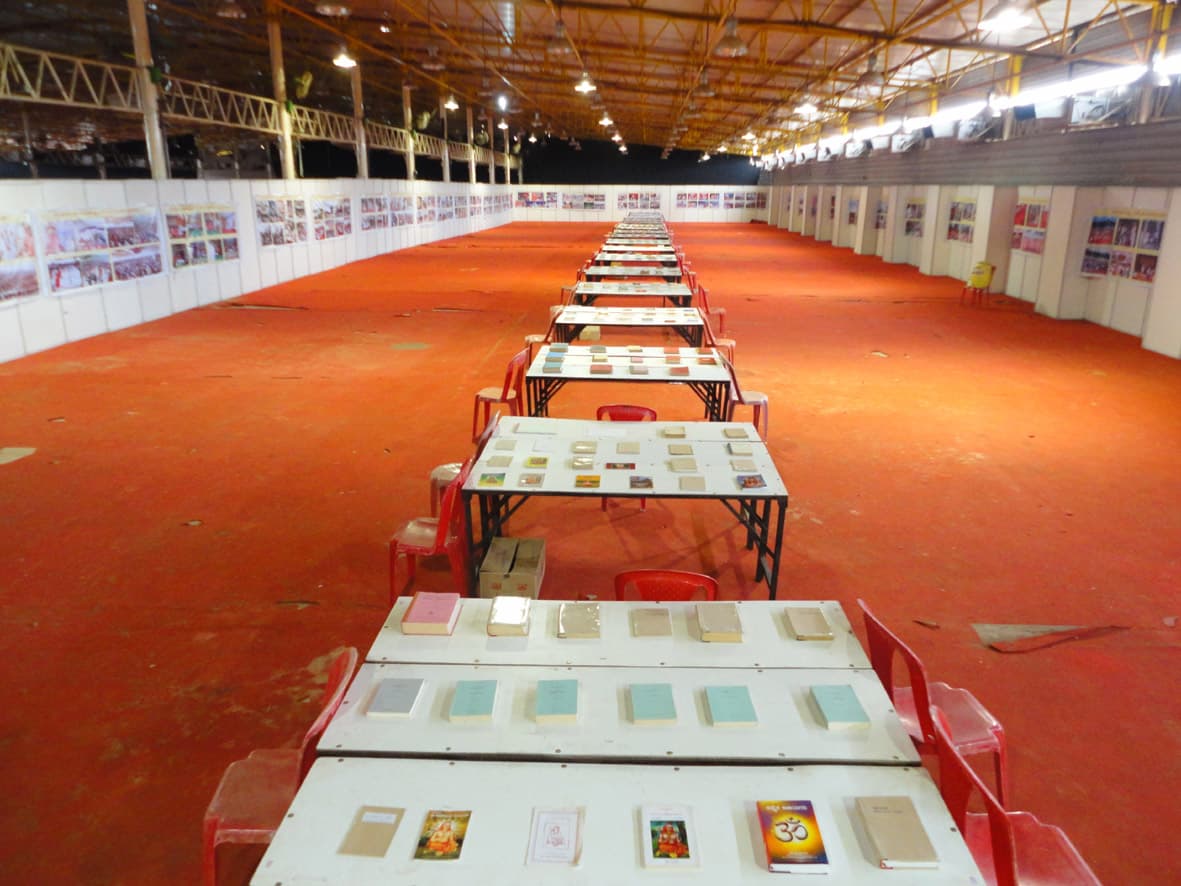
Śaṅkara Yaśovaibhava, organised by Vedanta Bharati in Bengaluru in May 2007, brought together a remarkable range of programmes celebrating the life, works and enduring legacy of Adi Shankaracharya. The celebrations included a large exhibition of books and literature on Śaṅkara, scholarly and devotional gatherings, and a Vedānta Vicāra Goṣṭhī that brought together distinguished Acharyas and scholars for reflection on his teachings and contributions. A special highlight was the Saundarya Lahari Samarpana, for which Vedanta Bharati undertook a year-long effort of preparation and mobilisation, culminating in a collective offering of Śaṅkara's celebrated hymn in the august presence of the Jagadgurus of the four Āmnāya Peethas. Through this wide-ranging celebration, Vedanta Bharati created a unique confluence of śāstra, scholarship, literature, devotion, music and public participation, bringing the works and vision of Adi Shankaracharya into the midst of society.
 The Chaturāmnāya Sammelan at the Shankarapuram Math — Śaṅkara Yaśovaibhava, May 2007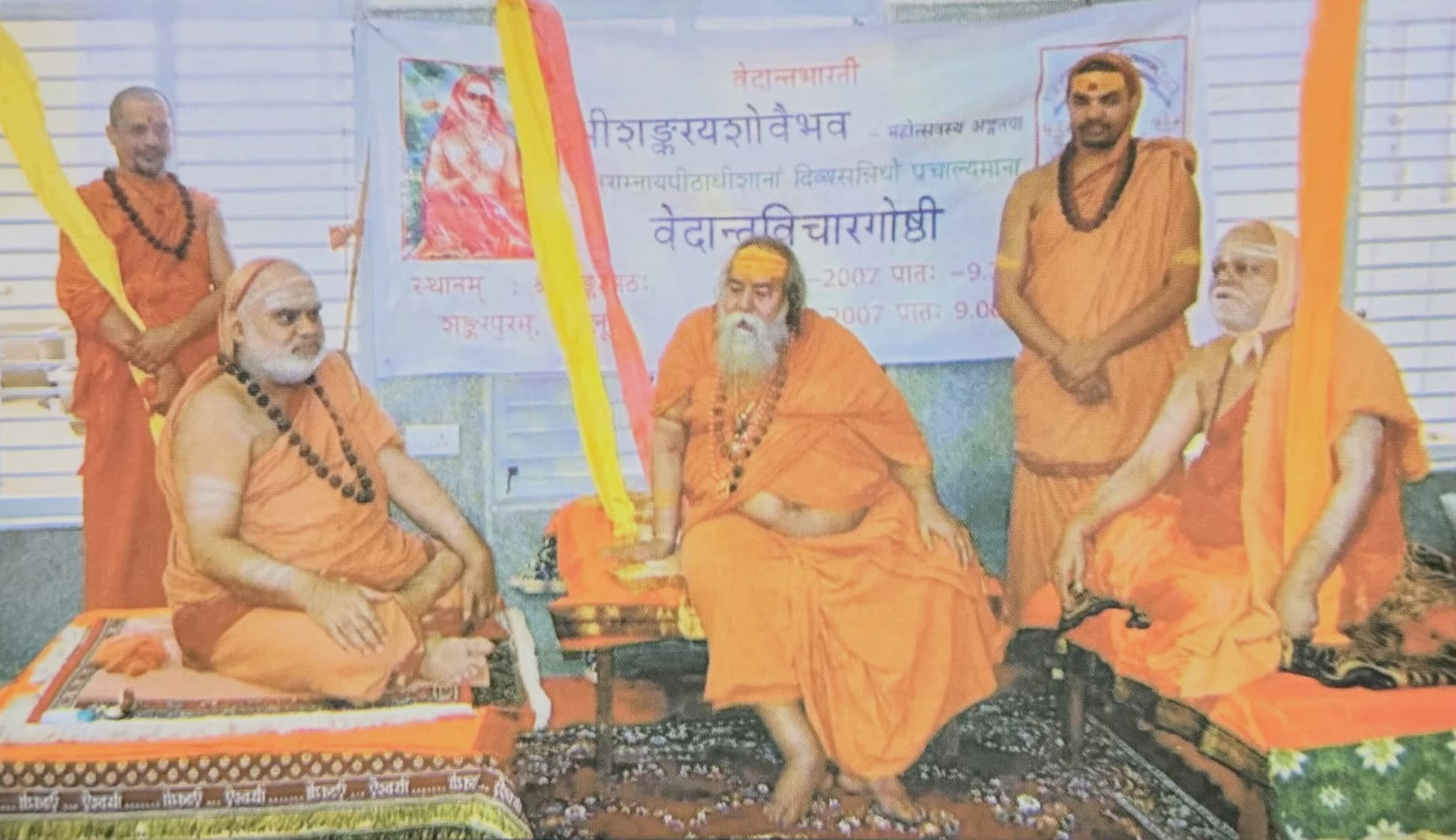
Anchor Three · A Gathering of Saints
Sant Samāveśa · A Gathering of the Saints
Over the years, Vedanta Bharati has convened Sant Samāveśas at some of India's most sacred centres, bringing together Sannyāsis, saints and spiritual leaders from diverse traditions for shared reflection on the tradition of Dharma and the timeless vision of Bhagavān Śrī Ādi Śaṅkarācārya. These gatherings were held at Sringeri, Haridwar during the Mahākumbha, Navi Mumbai and Varanasi, creating spaces for saints to meet, exchange insights and deliberate on the preservation and propagation of Bharat's philosophical and cultural heritage. The Samāveśas, held with the blessings and guidance of H.H. Sri Sri Shankara Bharati Mahaswamiji, reflect Vedanta Bharati's endeavour to foster dialogue, fellowship and a shared commitment to carrying forward the profound knowledge traditions of Bharat.
 Sannyāsis and saints gathered at a Sant Samāveśa, Navi Mumbai
Anchor Three · Annual Observance
Shankara Jayanti
Every year, Shankara Jayanti grows from a single day of celebration into a movement reaching thousands of local centres and households — each taking up Stotra Parayana exactly as Adi Shankaracharya envisaged it: steady, repeated recitation, undertaken in his honour.
 Discourse beside Adi Shankaracharya’s portrait
This year’s offering: the Sri Shankara Stavamala
For this year’s celebration, Vedanta Bharati has prescribed the Sri Shankara Stavamala — a curated set of hymns praising the life, mission and divinity of Adi Shankaracharya — recited household by household, across five days.
A Shodashopachara Puja to Sri Shankara follows the recitation each day, along with a discourse. Once the celebrations conclude, each centre sends a report of its observance back to Vedanta Bharati.
The Stavamala turns the day from ritual into contemplation — an expression of Guru Bhakti, and a yearly reminder of the Advaita Vedanta that quietly binds the nation together.
Photos — Shankara Jayanti
Get Involved
Bring This Work to Your Centre, School, or Institution
Centres interested in hosting a Stotra Parayana Samavesha, schools wishing to introduce Vivekadeepini, institutions interested in hosting a Bhaashyaamrita-Vaahinee discourse series, centres observing Shankara Jayanti, and devotees who would like to register interest in the next Maha Samarpane are all warmly invited to get in touch.
“By uniting thousands under a shared cultural legacy, this prakalpa — the community outreach and heritage-binding wing of Vedanta Bharati — strengthens the social fabric and promotes a sense of collective identity.”
HH Sri Sri Shankara Bharati Mahaswamiji