
Our Work · Vertical 3 of 5
Applied Adhyatma
& Inner Sciences
A disciplined intellectual and experiential exploration of Mind (Manas), Vitality (Prana) and Consciousness — through rigorous dialogue between Vedanta and modern science.
40+
Residential retreats since 2017
6+
Institutional research partnerships
6
Professional cohorts
Published
Outcome assessments at academic forums
An Overview: Where Ancient Inquiry Meets Contemporary Life
Applied Adhyatma & Inner Sciences is Vedanta Bharati's most sustained engagement between Advaita Vedanta and the modern professions. Since 2017, the vertical has reached doctors, psychiatrists, IT professionals, lawyers, chartered accountants, government officers, and educators. This work has taken shape through residential retreats at Japadakatte on the banks of the Cauvery, hospital engagements, IIT sessions, management institutions, and two international conferences in Ayodhya.
The Upanishads do not offer a set of beliefs to be accepted — they offer a precise, structured account of what the human Mind is, how it functions, what animates it, and what lies beyond it. Advaita Vedanta is not philosophy in the abstract sense. It is a rigorous epistemological framework with specific claims about Consciousness, perception, and the nature of the Self — claims that are, in principle, amenable to scientific investigation.
The vertical operates on a disciplined conviction: that the Vedantic framework — the Antahkarana model of Mind, the Pañcha Kosha framework, the Avasthā Traya (three states of Consciousness), and the systematic methodology of Neti-Neti — provides not mere philosophy but a set of hypotheses to be tested. Every program brings these hypotheses into dialogue with the scientific accounts offered by neurosurgeons, psychiatrists, psychologists, and clinical researchers. Both traditions are held to the same standard of rigour.
All programs under this vertical are conducted in the divine presence of HH Sri Sri Shankara Bharati Mahaswamiji, the Peethadheeshwar of Yadathore Sri Yoganandeshwara Saraswathi Math, K.R. Nagar, Mysore — whose guidance grounds every inquiry in the living tradition of Advaita Vedanta.
Where It All Began
Japadakatte, Hebsur — On the Banks of the Cauvery
The initial residential retreats of this vertical were rooted at Japadakatte — on the sacred banks of the Cauvery, where the river flows from north to south. The environment at Japadakatte — designed for sustained inquiry, with guided meditation on the riverbank by Sri Sri Shankara Bharati Swamiji, Stotra parayana, and bhajans woven through the schedule — gave the program its foundational character. From this origin, the work grew: first to city venues across Karnataka, then to Bengaluru, Shimoga, and Gulbarga, and then further outward — to Delhi, Lucknow, Kanpur, Ayodhya, and Kalady — following the routes of Adi Shankaracharya's own digvijaya and of HH's Akhand Bharat Vijaya Yatras.
Inquiry Themes: The Architecture of Every Program
Every program is structured around two themes — drawn from one or both, calibrated to the cohort.
Theme 1
The Mind — Its Nature, Architecture & Mastery
Brings the Vedantic Antahkarana model into direct dialogue with neuroscience, psychiatry, and clinical research.
Theme 2
The Examined Profession
Asks what Advaita Vedanta knows about the inner life of medicine, law, finance, technology, education, and governance that professional training has not addressed.
Theme 1
The Mind — Its Nature, Architecture & Mastery
उद्धरेदात्मनात्मानं नात्मानमवसादयेत् ।
आत्मैव ह्यात्मनो बन्धुरात्मैव रिपुरात्मन: ।।
Let a person lift themselves by their own self, and not let the self be degraded. For the self alone is the friend of the self, and the self alone is the enemy of the self.
Bhagavad Gita · Chapter VI, Verse 5 · The central invocation of every program
This theme brings together the two most rigorous accounts of the Mind that human inquiry has produced — the modern scientific account and the Vedantic account — and holds them in direct, structured dialogue. Neither is treated as superior. Both are subjected to the same demand: show us what you actually know, and where your account runs out. The inquiry covers the following domains, each addressed from both perspectives:
Nature of Mind
What is the Mind? Is it the brain? Is it reducible to neural activity? What does Advaita Vedanta say that neuroscience does not yet have the tools to address?
Brain & Mind
The distinction between brain (the organ) and Mind (the function, or something beyond) — examined through both neuroscientific research and the Antahkarana model.
Breath & Mind
The relationship between Prana, breath, and the quality of mental activity — explored through clinical respiratory research and the Prānamaya Kosha framework.
Yoga & Mind
What does a sustained yoga practice do to the Mind — and to the brain? What does the neuroscience say, and how does Advaita Vedanta understand what is actually happening?
Brain Waves & Stotras
The neurological and cognitive effects of structured Stotra recitation — at the intersection of Sanskrit scholarship and empirical neuroscience.
Control of Mind
Can the Mind be trained, regulated, and ultimately transcended? What does Advaita Vedanta offer as method, and where does the literature on attention and metacognition converge?
The scientific perspective is presented by neurosurgeons, psychiatrists, psychologists, and clinical researchers from premier medical institutions across India. The Vedantic perspective is elucidated by Vidwans from the Yadathore Math, the Sringeri Math, and associated scholarly lineages. The foundational texts anchoring this theme include the Upanishads — particularly the Taittirīya and Mandukya — alongside the Bhagavad Gita and Vidyaranya's Panchadashi.
Theme 2
The Examined Profession — Vedantic Inquiry in Professional Life
The Vedantic framework offers a precise diagnosis of how the Antahkarana functions under the specific conditions of each profession — the particular ethical tensions, attentional demands, and Consciousness-pressures that belong distinctively to medicine, law, finance, technology, education, and governance. Every profession creates its own characteristic distortions of the Mind. Advaita Vedanta names them precisely — and offers a methodology for working through them.
Doctors & Healthcare
The clinical frontier of Consciousness. The Pañcha Kosha framework offers a clinical map of the human system beyond the biomedical model — with structured pre- and post-outcome assessments examining measurable change in professional orientation.
Lawyers & Legal Professionals
Dharma in the adversarial arena. The obligation to pursue outcomes that may conflict with personal ethical conviction — the Vedantic concept of Dharma offers a rigorous vocabulary their training rarely addresses.
IT Professionals
Mind, intelligence, and artificial intelligence. What is intelligence, and what is it not? What does the Vedantic account of Mind say about attention, cognition, and Consciousness that the AI research community has not yet systematised?
Chartered Accountants
Viveka in financial life. The discriminative intelligence — Viveka — that Advaita Vedanta has cultivated for millennia, applied to professional integrity and the management of desire in financial decision-making.
Management Professionals
Leadership as a quality of Antahkarana. Leadership is not a competency to be acquired but a quality of the inner instrument — the degree to which the Antahkarana is purified, clear, and oriented beyond self-interest.
Educators & Teachers
The formation of the next generation. What the Guru-Shishya tradition knows about attention, presence, and the formation of the Mind that contemporary pedagogy has yet to integrate.
Government Officers
Dharma in public service. The IAS and IFS officer operates at the interface of policy, power, and the public good — where the Vedantic framework of ethical action under institutional pressure has direct, underexplored relevance.
Students & Pre-Professionals
Orientation before formation. A foundational encounter with Vedantic frameworks of Mind, identity, and purpose before the patterns that shape a career have hardened — carrying a compounding effect across a lifetime.
Research: A Live Research Laboratory
Applied Adhyatma is not a standalone program — it is a live research laboratory. Participant cohorts are subjects of structured, outcome-based assessments presented at academic forums and conference proceedings. Two formal MoU partnerships anchor the research dimension: NIMHANS Centre for Consciousness Studies (Bengaluru) — brain wave research during pranayama, effects Stotra recitation might have on the subconscious; and NIAS at IISc (Bengaluru) — conceptual problems in mathematics and physics in relation to Vedantic teachings. Collaborative partnerships with other leading medical institutions and hospitals enable multi-centric research, bringing diverse clinical and academic perspectives together to explore the interface between traditional knowledge and contemporary science.
Formal Institutional Partnerships — MoU
National Institute of Mental Health and Neurosciences (NIMHANS)
Centre for Consciousness Studies · Bengaluru
Research focus: the effects Stotra recitation might have on the Mind and the subconscious Mind; evaluation of brain wave functioning during pranayama and meditation. The partnership brings rigorous clinical methodology to questions Advaita Vedanta has addressed for millennia — producing findings that are both scientifically publishable and philosophically significant.
National Institute of Advanced Studies (NIAS)
IISc Campus, Bengaluru
Research focus: evaluation of conceptual problems in mathematics and physics and their solutions in relation to Vedantic teachings. The inquiry asks whether the structural insights of Advaita Vedanta offer genuine epistemological tools for resolving foundational conceptual problems in modern science — not as metaphor, but as rigorous philosophical framework.
Informal Research Collaborations — Multi-Centric Studies
An active network of collaborations with leading medical institutions across India enables multi-centric studies on topics related to Advaita Vedanta, Consciousness, and the Mind.
Narayana Institute of Neuro Sciences
Bengaluru
M.S. Ramaiah Institute of Medical Sciences
Bengaluru
Sathya Sai Institute of Medical Sciences
Bengaluru
Gulbarga Medical College
Gulbarga, Karnataka
All India Institute of Medical Sciences
New Delhi
Sir Ganga Ram Hospital
New Delhi
Research Collaboration Enquiry: Academic institutions and researchers interested in multi-centric studies on Advaita Vedanta, Consciousness, and the Mind are invited to contact Vedanta Bharati. Findings from all formal research partnerships are presented at peer-reviewed academic forums and conference proceedings.
Flagship Program: Chidrūpam
We have mapped the brain, measured every neuron, and tracked the neurochemistry of every thought. Yet the mystery persists: why and how do physical processes give rise to subjective experience? No computational or neurological account — not GNWT, not IIT, not HOT, not RPT — has resolved what philosopher David Chalmers called the Hard Problem of Consciousness. Chidrūpam proposes that the missing dimension is not more data — it is a different epistemological starting point. Using Neti-Neti, the Upanishads isolate Consciousness directly.
Program Record: Where This Work Has Happened
40+ residential retreats since 2017 — from Japadakatte to international conferences in Ayodhya. Hospitals, IITs, universities, bar associations, and management bodies across India.
 HH presiding
Program Record
Residential retreats, hospitals, universities, conferences, management bodies
Conference
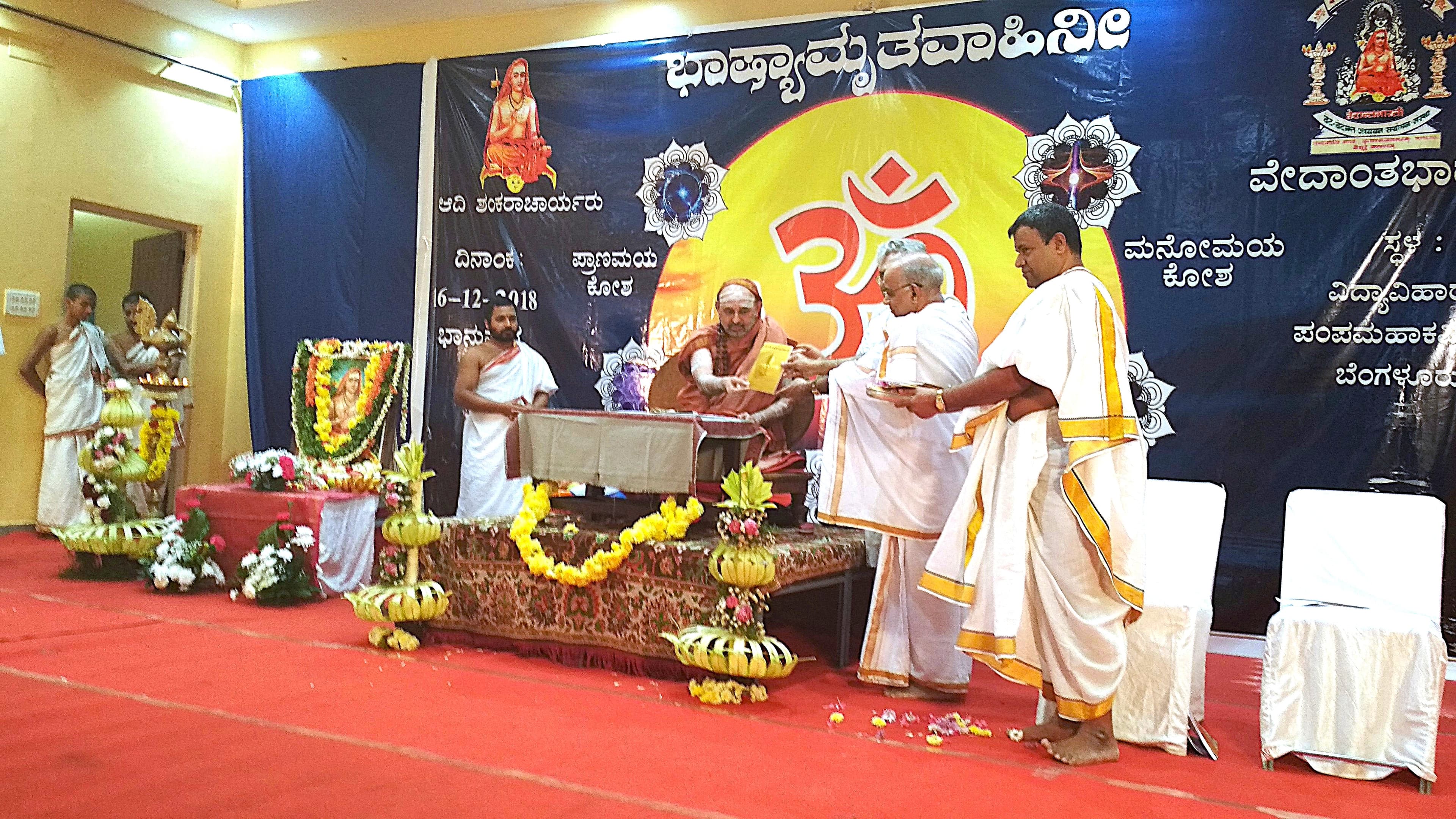
Bhaashyaamrita-Vaahinee — Taittirīya Upanishad Bhashya
40 centres across Bengaluru, concluding at Sringeri Shankara Math, Chamarajapet
A week-long city-wide initiative of unprecedented scale — discourses on Shankaracharya's Taittirīya Upanishad Bhashya conducted simultaneously at 40 centres across Bengaluru, in Kannada and English, by scholars trained in the traditional Guru-Shishya lineage.
Conference
Impact of Adi Shankaracharya's Teachings on Indian Culture
Ramakrishna Math, Basavanagudi, Bengaluru
This lecture series examined the deeper philosophical contribution of Adi Shankaracharya: how his insistence on the primacy of Jnana and the non-dual nature of reality shaped India's intellectual tradition in ways still structurally present in how Indian thought approaches identity, knowledge, and action.
Residential Retreat
Samanvaya in Bhagavad Gita
Sri Jayarama Seva Mandali, Jayanagara, Bengaluru
The Bhagavad Gita's philosophical coherence — its integration of Karma Yoga, Jnana Yoga, and Bhakti within a single consistent framework — is often underestimated. This session engaged the concept of Samanvaya through the lens of a researcher who approaches ancient texts with the tools of modern scholarship.
Residential Retreat
Quantum & Vedanta
Sri Jayarama Seva Mandali, Jayanagara, Bengaluru
The observer-dependence of quantum measurement and the Vedantic concept of the Witness (Sākshi) share a structural similarity that is not merely metaphorical. This session engaged that similarity with the precision it demands — a physicist from IIT Delhi examining what the observer actually means in quantum theory.
Residential Retreat
Mind Series — Train, Boost, Educate, Judge, Therapise
Sri Jayarama Seva Mandali, Jayanagara, Bengaluru
The Chaturmasya retreat cycle of 2024 was the most architecturally sophisticated series the programme has produced — eleven sessions over eight weeks, each addressing the mind from a distinct angle: its training, its boosting, its scientific and Vedantic aspects, its therapeutic dimensions.
Conference
Panchakosha — Modern & Ancient Perspectives on Mind Healing
Sri Jayarama Seva Mandali, Jayanagara, Bengaluru
The most sustained institutional collaboration in the programme's history — a full-day event co-organised with NIMHANS during Chaturmasya 2024. Each of the five koshas was presented by a NIMHANS faculty member as a research domain before being examined through the Vedantic lens.
Conference
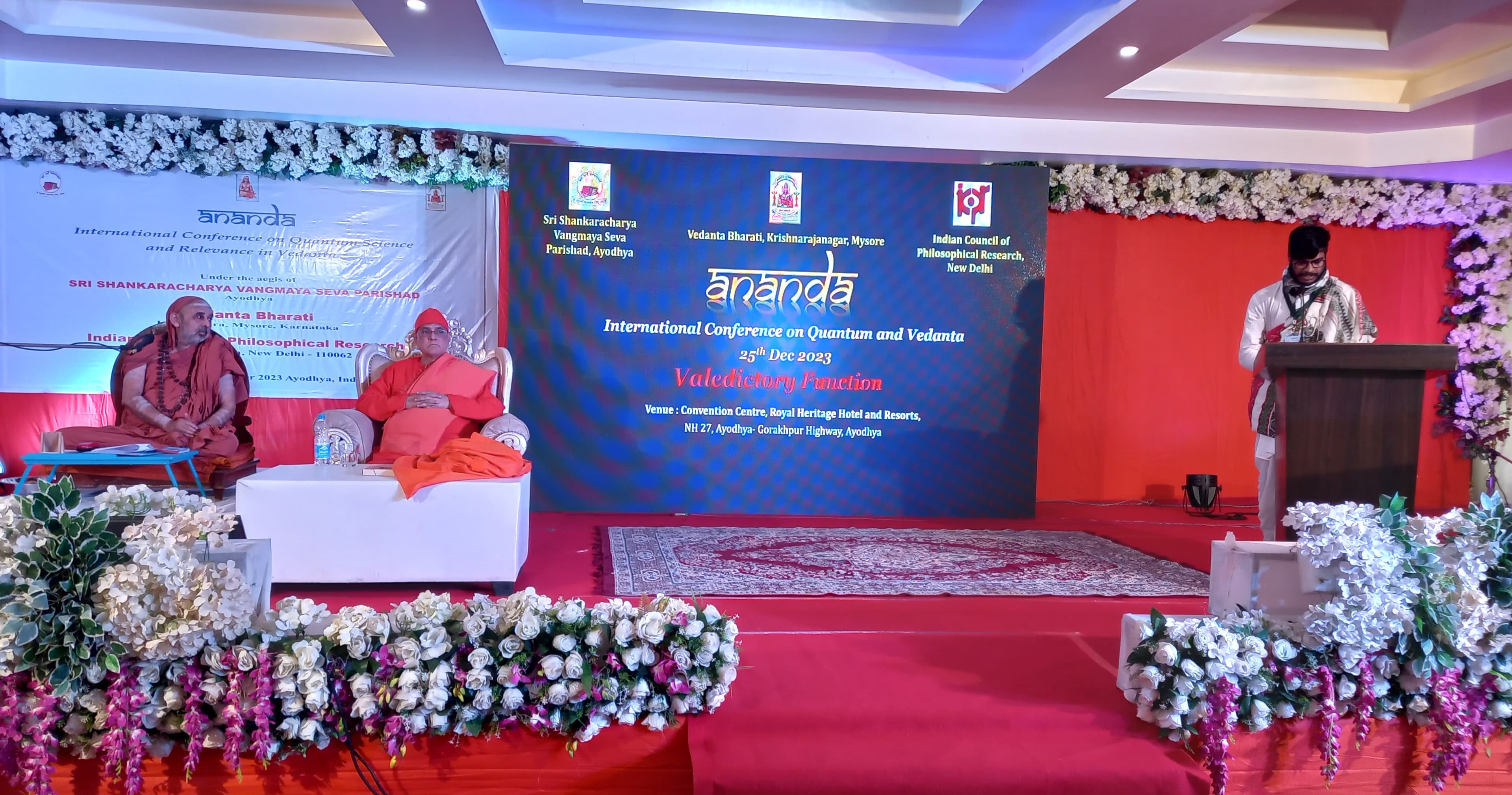
ANANDA — Quantum Science & Relevance in Vedanta
Convention Centre, Royal Heritage Hotel, Ayodhya
The 2022 Nobel Prize in Physics — awarded for experimental verification that the universe is not locally real — reignited a question Advaita Vedanta has been answering for millennia. This conference brought physicists, mathematicians, and Vedanta scholars together to examine the converging implications.
Conference
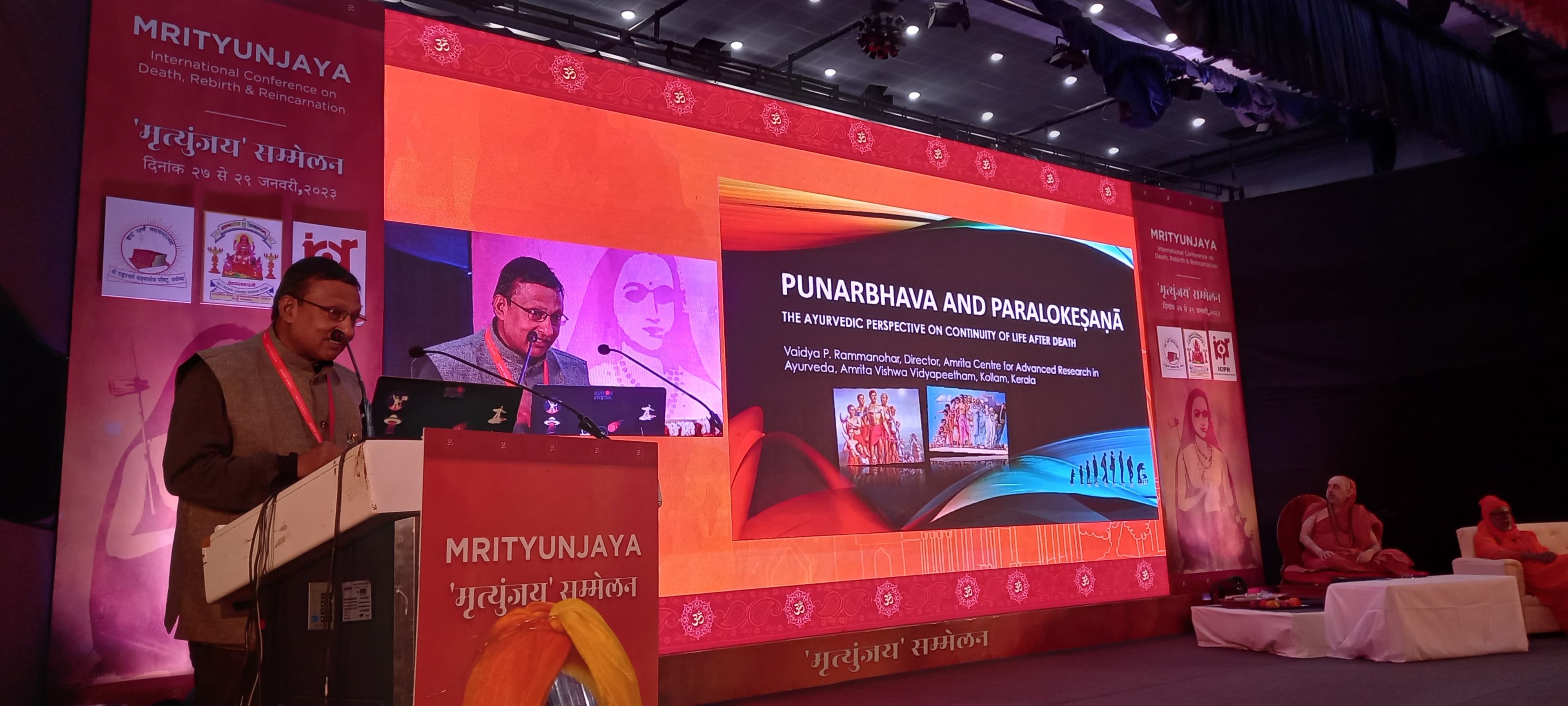
MRITYUNJAYA — Death, Rebirth & Reincarnation
Dr. Ram Manohar Lohia Avadh University, Ayodhya
Scientific Committee & Attendees — Working President: Padma Shri Dr. B.N. Gangadhar (Prof. Emeritus, NIMHANS) · Psychiatrists (Mayo Clinic USA, Apollo) · Anthropologists (Delhi University) · Ayurvedic researchers (Amrita) · IIT Bombay faculty · Advaita Vedanta scholars
Mrityunjaya assembled an extraordinary cross-section of investigators — psychiatrists who encounter questions of identity in extremis daily, anthropologists who study continuity of personhood, ayurvedic researchers examining life transitions, and Vedanta scholars — to examine the evidence together in Ayodhya.
University / IIT
Nature and Control of Mind
NIT Raipur — M. Visvesvaraya Hall, Chhattisgarh
A National Institute of Technology provided the setting for a structured examination of mind from both scientific and Vedantic perspectives. The dual-talk format — a consultant psychiatrist presenting the scientific account, followed by the Vedantic perspective — highlighted precise points of convergence and divergence.
University / IIT
Shankara Vedanta & Its Implication on Students' Life
Tripura University (Central University), Suryamaninagar
A special lecture series examined the practical implications of Shankara's Vedanta for the formation of students — asking what Vedantic education means for the formation of citizens rather than merely professionals.
University / IIT
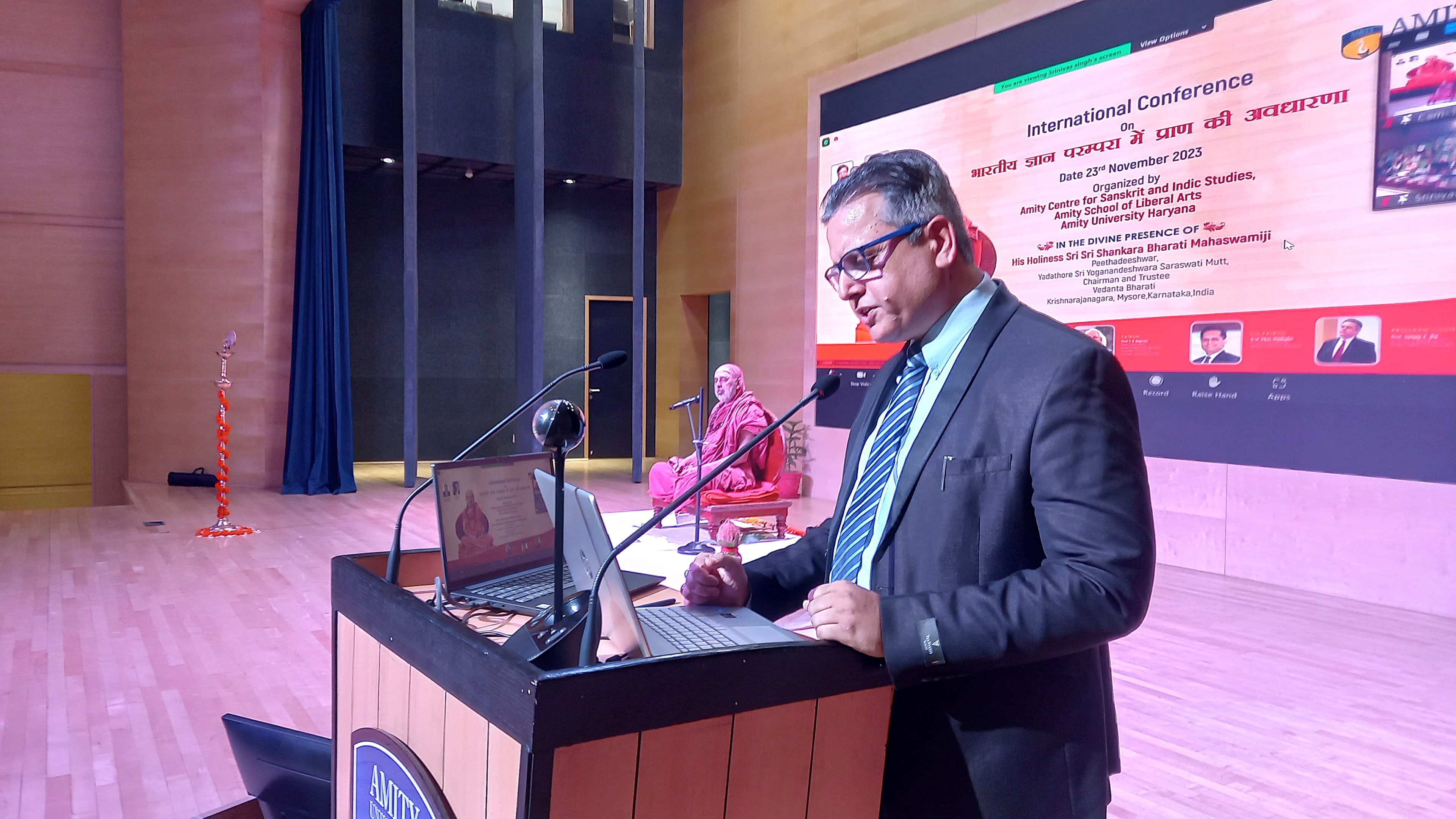
Concept of Prana in Indian Knowledge Tradition
Amity University, Gurugram — International Conference
An international conference examined Prana as a concept within Indian epistemology — not as an alternative medicine construct but as a sophisticated framework within one of the world's oldest systematic knowledge traditions.
University / IIT
Mind, Its Nature & Function
Saankara Jyothi, Kalady, Kerala
Held at Kalady — the birthplace of Adi Shankaracharya — this one-day programme placed the scientific and Vedantic accounts of mind in direct sequential dialogue. A psychiatrist and a neurologist presented the biomedical understanding before it was examined through the Upanishadic lens.
Residential Retreat
Reincarnation: Fact or Fiction? — An Empirical Examination
Japadakatte, Hebsur, Karnataka
The question of rebirth sits at the precise boundary between empirical investigation and philosophical inference. This programme brought a scholar with formal training in Sankhya, Advaita Vedanta, and Nyaya to examine what empirical evidence actually exists for continuity of consciousness across lifetimes.
Residential Retreat
Panchadashi for Doctors
Sri Ramashankaraprasada, Bengaluru
The Panchadashi — Vidyaranya's fourteenth-century systematic text on Advaita Vedanta — proceeds through fifteen chapters with the precision of a philosophical treatise. This session introduced medical professionals to a text that treats its subject with the same rigour they apply to clinical diagnosis.
University / IIT
Concepts of Self and Its Relevance in Mental Health
NIMHANS, Auditorium B, Bengaluru
A landmark public lecture series at NIMHANS. The series examined what the Upanishadic account of Ātman — the unchanging witness behind all mental states — might contribute to clinical approaches to identity, psychopathology, and disordered self-concept.
University / IIT
Relevance of Vedanta in Modern Times
Ram Manohar Lohia Medical Sciences, Lucknow
Medical students are trained to understand the human body with extraordinary precision — and then encounter questions about suffering, identity, and consciousness that the biomedical curriculum leaves entirely unaddressed.
University / IIT
Advaita — A Framework for Contemporary Inquiry
IIT Lucknow, Uttar Pradesh
Advaita Vedanta is often received by technically-trained audiences as a philosophical curiosity. This programme was designed to challenge that assumption directly — presenting Advaita as a rigorous epistemological framework with specific claims amenable to scientific investigation.
Management & Legal
Leadership Matters: Management & Spiritual Perspectives
Lucknow Management Association, Smriti Bhawan, Lucknow
Leadership, in the Vedantic framework, is not a competency — it is a quality of Antahkarana. This programme brought together the management and Vedantic traditions in direct dialogue.
University / IIT
Understanding Prana for Mindful Meditation
Vivekananda Polyclinic & Institute of Medical Sciences, Lucknow
Organised jointly with Vivekananda Polyclinic, this programme brought together the Vedantic concept of Prana with contemporary clinical interest in mindfulness and attentional regulation.
Hospital Program
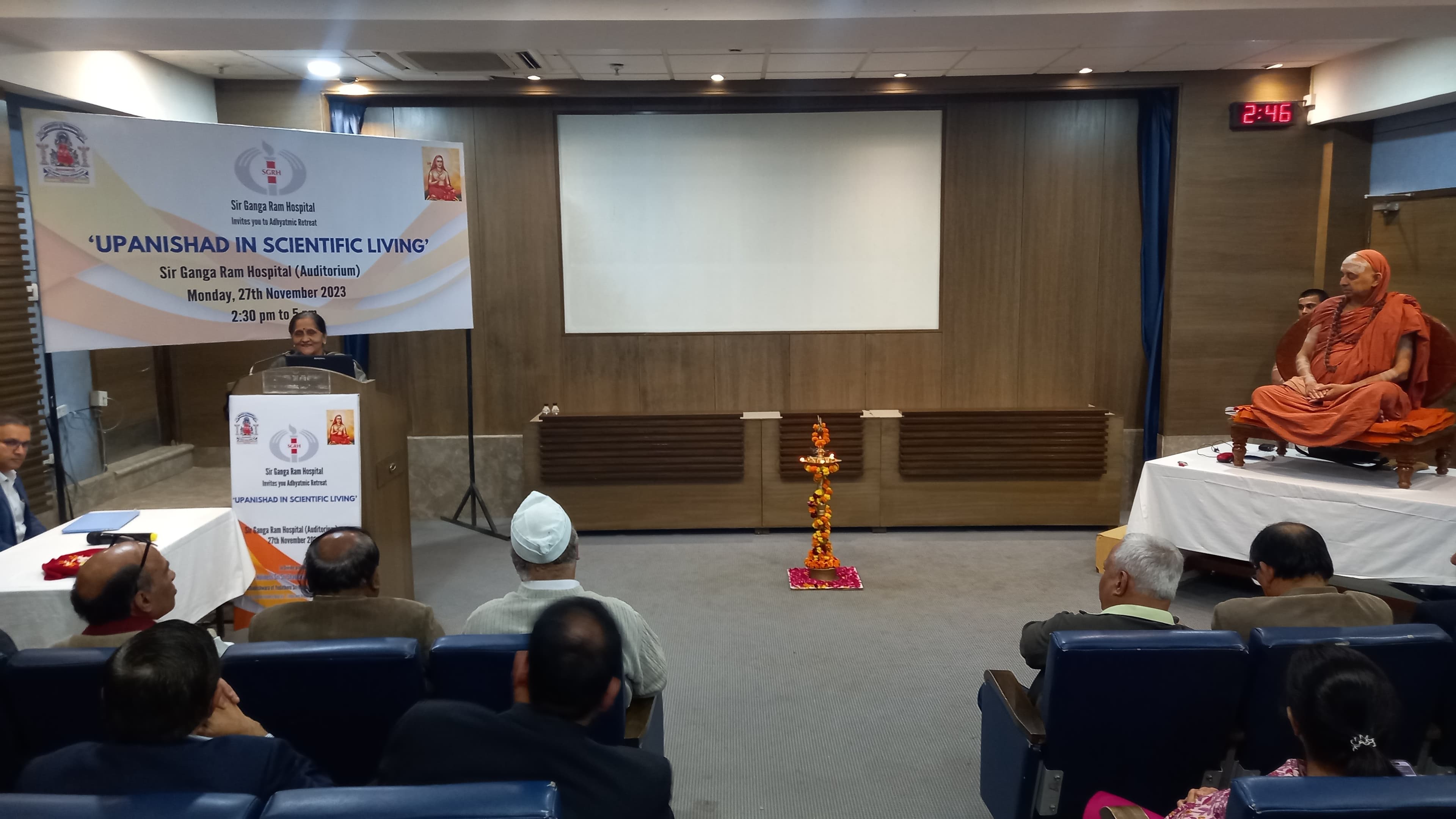
Upanishad in Scientific Living
Sir Ganga Ram Hospital, New Delhi
A follow-on programme exploring what it would mean for the Upanishadic framework to inform not just professional practice but the structure of a scientifically-grounded life.
Hospital Program
Science of Prana & Upanishad
Sir Ganga Ram Hospital, New Delhi
The concept of Prana is treated in modern biomedicine as a pre-scientific construct. This programme set out to test that assumption, bringing together senior clinicians to examine what the Upanishadic account of Prānamaya Kosha actually claims and what it would mean for those claims to be empirically investigated.
Hospital Program
Retreat on 'The Mind' — Medical Professionals
Laxmi Lawns and Resort, Lucknow, Uttar Pradesh
A convergence of medical science and Vedantic inquiry in a full-day format — two sessions, 'What is Mind' and 'Mind Your Mind', framing the inquiry both scientifically and philosophically. Neurologists and psychiatrists presented the biomedical account before it was examined through the Upanishadic lens.
Hospital Program
Adhyatmic Chintan — Medical Professionals
Safdarjung Hospital, New Delhi
A half-day programme at one of India's largest government hospitals — a setting where medical professionals encounter questions of life, death, suffering, and consciousness in their most acute form every day.
University / IIT
Effect of Stotras on the Mind
IIT Kanpur, Uttar Pradesh
A session at one of India's premier technical institutions examined a question that sits at the precise intersection of neuroscience and Sanskrit tradition: does structured chanting of Stotras produce measurable and reproducible effects on cognitive and emotional states?
Residential Retreat
Japadakatte Residential Series
Japadakatte, Hebsur, Karnataka
The residential cycle at Japadakatte deepened into a sustained curriculum, with successive cohorts building on foundational sessions to engage with primary Upanishadic texts. The Taittirīya Upanishad became a recurring anchor — its Pañcha Kosha framework offering a precise anatomical map of the human system.
Residential Retreat
Adhyatma Shibira — Professional Cohort Series
Japadakatte, Hebsur & City Venues across Karnataka
The first year of the programme was defined by breadth — a deliberate effort to test Vedantic frameworks across radically different professional constituencies. What emerged was a consistent finding: the questions of Manas, Prana, and identity are not domain-specific.

Residential Retreat
Retreat on the Mind — Inception
Japadakatte, Hebsur, Karnataka
25 doctors — neurosurgeon, anaesthesiologist, psychiatrist, orthopaedic surgeon, ophthalmologists, oncologists, psychologists, physicians
The programme that started everything. A small, carefully constituted group of medical professionals gathered to examine a deceptively simple question: what is the mind, and can Vedanta offer a clinically meaningful account of it? The retreat format — overnight, away from institutional settings — allowed participants to engage not as professionals defending positions, but as inquirers confronting the same fundamental questions their patients do.
Register or Bring This Program to Your Organisation
Register interest for the next residential retreat — the Doctors' Cohort at Japadakatte, residential and by approval, with limited seats. Bring the program to your institution — hospital, IIT, law school, management body, or corporate organisation. Or begin a research collaboration — academic institutions and researchers interested in multi-centric studies on Advaita Vedanta, Consciousness, and the Mind are invited to initiate contact.